

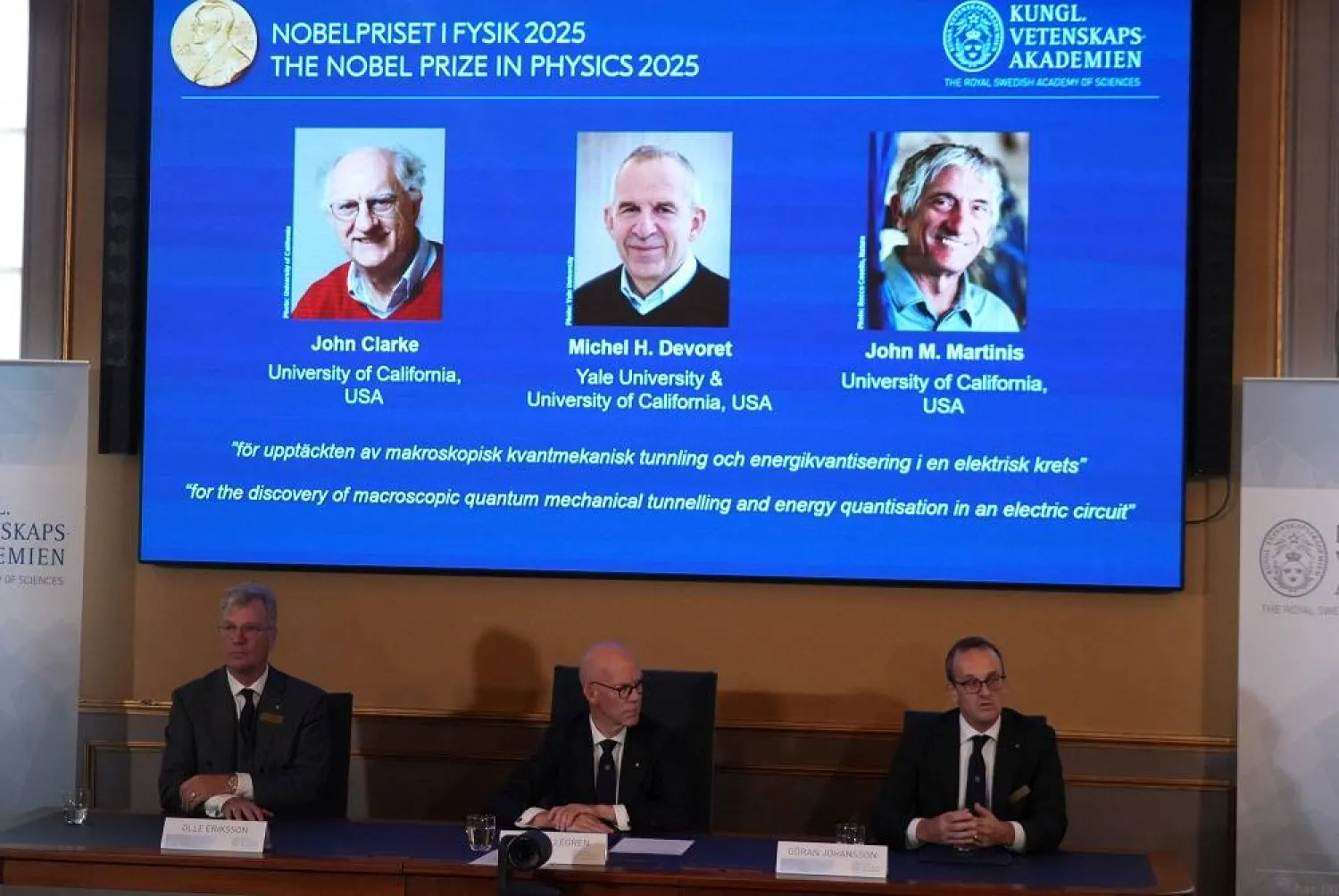

Nobel Prize in Physics Goes to 3 Scientists Whose Work Advanced Quantum Technology 

John Clarke, Michel H. Devoret and John M. Martinis are announced this year's Nobel Prize winners in Physics, by the Royal Swedish Academy of Sciences at a press conference in Stockholm, Sweden October 7, 2025. (Reuters)
TT

Nobel Prize in Physics Goes to 3 Scientists Whose Work Advanced Quantum Technology 

John Clarke, Michel H. Devoret and John M. Martinis are announced this year's Nobel Prize winners in Physics, by the Royal Swedish Academy of Sciences at a press conference in Stockholm, Sweden October 7, 2025. (Reuters)

John Clarke, Michel H. Devoret and John M. Martinis won the Nobel Prize in Physics on Tuesday for research on seemingly obscure quantum tunneling that is advancing digital technology.

Clarke, 83, conducted his research at the University of California, Berkeley; Martinis at the University of California, Santa Barbara; and Devoret at Yale and also at the University of California, Santa Barbara.

“To put it mildly, it was the surprise of my life,” Clarke told reporters at the announcement by phone after being told of his win.

He paid tribute to the other two laureates, saying that “their contributions are just overwhelming."

“Our discovery in some ways is the basis of quantum computing. Exactly at this moment where this fits in is not entirely clear to me.”

However, speaking from his cellphone, Clarke added: “One of the underlying reasons that cellphones work is because of all this work.’’

The Nobel committee said that the laureates' work in the 1980s continues to provide opportunities to develop “the next generation of quantum technology, including quantum cryptography, quantum computers, and quantum sensors.”

“It is wonderful to be able to celebrate the way that century-old quantum mechanics continually offers new surprises. It is also enormously useful, as quantum mechanics is the foundation of all digital technology,” said Olle Eriksson, Chair of the Nobel Committee for Physics.

The 100-year-old field of quantum mechanics deals with the seemingly impossible subatomic world where switches can be on and off at the same time and parts of atoms tunnel through what seems like impenetrable barriers. The prize-winning trio’s work helped take that into the larger world, where it has the potential to supercharge computing and communications.

What the three physicists did “is taking the scale of something that we can’t see, we can’t touch, we can’t feel and bringing it up to the scale of something recognizable and make it something you can build upon,” said Physics Today editor-in-chief Richard Fitzgerald, who in the 1990s worked in the field on a competitors’ group.

“Quantum computers is one very sort of obvious use, but they’re also can be used for quantum sensors, so to be able to make very sensitive measurements of, for example, magnetic fields, and perhaps also for cryptography, so to encode information so it cannot be easily listened to by a third party,” Mark Pearce, a professor of astrophysics and Nobel Physics Committee member, told The Associated Press.

It is the 119th time the prize has been awarded. Last year, artificial intelligence pioneers John Hopfield and Geoffrey Hinton won the physics prize for helping create the building blocks of machine learning.

On Monday, Mary E. Brunkow, Fred Ramsdell and Dr. Shimon Sakaguchi won the Nobel Prize in medicine on Monday for discoveries about how the immune system knows to attack germs and not our bodies.

Nobel announcements continue with the chemistry prize on Wednesday and literature on Thursday. The Nobel Peace Prize will be announced Friday and the Nobel Memorial Prize in economics on Oct. 13.

The award ceremony will be held Dec. 10, the anniversary of the 1896 death of Alfred Nobel, the wealthy Swedish industrialist and the inventor of dynamite who founded the prizes.

The prizes carry priceless prestige and a cash award of 11 million Swedish kronor (nearly $1.2 million).


Research Reveals Decades-Long Silverpit Crater Triggered by Tsunami 40 Million Years Ago

A massive asteroid struck the North Sea millions of years ago (Getty)
TT

Research Reveals Decades-Long Silverpit Crater Triggered by Tsunami 40 Million Years Ago

A massive asteroid struck the North Sea millions of years ago (Getty)

A long-running dispute about the origin of a North Sea crater has finally been settled, as new research finds a massive asteroid hit the water and triggered a towering tsunami millions of years ago.

Scientists have found that the Silverpit Crater – which lies around 700 meters beneath the southern North Sea seabed, roughly 80 miles off the coast of Yorkshire – was formed when an asteroid or comet struck the region roughly 43 to 46 million years ago, sparking a 330 feet tsunami.

Since geologists first identified the formation in 2002, the 3km-wide crater and its surrounding ring of circular faults spanning about 20 km have sparked intense debate, according to The Independent.

But researchers say their new study marks the clearest evidence yet that the structure is one of Earth’s rare impact craters.

This confirmation places it in the same category as well-known structures such as the Chicxulub Crater in Mexico, which is linked to the dinosaur mass extinction.

The team used computer modelling and analyzed newly available seismic imaging and microscopic geological samples taken from beneath the seabed.

Dr. Uisdean Nicholson, a sedimentologist in Heriot-Watt University’s School of Energy, Geoscience, Infrastructure and Society, who led the investigation, said: “New seismic imaging has given us an unprecedented look at the crater.”

He said samples from an oil well in the area also revealed rare ‘shocked’ quartz and feldspar crystals at the same depth as the crater floor.

“We were exceptionally lucky to find these – a real ‘needle-in-a-haystack’ effort. These prove the impact crater hypothesis beyond doubt, because they have a fabric that can only be created by extreme shock pressures,” said Nicholson.

The scientists say these microscopic minerals form only under the extreme pressures generated during asteroid impacts, providing strong confirmation of the event.

Early research proposed that the feature was created by a high-speed asteroid impact. Supporters of that idea pointed to its round shape, central peak, and surrounding concentric faults, which are often seen in known impact craters.

But other scientists suggested different explanations. Some proposed that underground salt movement distorted the rock layers and created the structure.

Others argued that volcanic activity may have caused the seabed to collapse.

In 2009, geologists even voted on the issue. According to a report in the December 2009 issue of Geoscientist magazine, most participants rejected the asteroid impact explanation at the time.

The latest findings, published in the journal Nature Communications and funded by the Natural Environment Research Council (NERC), now appear to overturn that conclusion.

Dr. Nicholson said: “Our evidence shows that a 160-meter-wide asteroid hit the seabed at a low angle from the west.”

“Within minutes, it created a 1.5 km high curtain of rock and water that then collapsed into the sea, creating a tsunami over 100 meters high.”

The impact would have produced a violent explosion at the seafloor and sent enormous waves spreading across the region.

Professor Gareth Collins, of Imperial College London, who attended the 2009 debate about the crater’s origin and contributed to the new research, said the researchers have “finally found the silver bullet” to end the debate.

He said: “I always thought that the impact hypothesis was the simplest explanation and most consistent with the observations.”

“It is very rewarding to have finally found the silver bullet. We can now get on with the exciting job of using the amazing new data to learn more about how impacts shape planets below the surface, which is really hard to do on other planets,” Collins added.

Dr. Nicholson also expressed his excitement about using the new findings for further research into asteroids.

“Silverpit is a rare and exceptionally preserved hypervelocity impact crater,” he said.

“These are rare because the Earth is such a dynamic planet – plate tectonics and erosion destroy almost all traces of most of these events.”


Naples Museum to Allow Visually Impaired Visitors to Experience Art Through Touch

Giuseppe Sanmartino's sculpture of the Veiled Christ housed in the Sansevero Chapel in Naples, Italy, 10 March 2026. EPA/CIRO FUSCO
TT

Naples Museum to Allow Visually Impaired Visitors to Experience Art Through Touch

Giuseppe Sanmartino's sculpture of the Veiled Christ housed in the Sansevero Chapel in Naples, Italy, 10 March 2026. EPA/CIRO FUSCO

The Sansevero Chapel Museum in Naples will allow dozens of visually impaired visitors to take part in a rare tactile experience, letting them touch celebrated works of art including the Veiled Christ, which is widely regarded as one of the most striking masterpieces in the history of sculpture.

On March 17, the museum will host an initiative called La meraviglia a portata di mano – Wonder within reach – organized in partnership with the Italian Union of the Blind and Visually Impaired of Naples, offering about 80 blind and partially sighted visitors a chance to encounter the marble masterpieces.

According to The Guardian, visitors will be guided through the chapel by guides who are also visually impaired in a program designed to place accessibility at the center of the museum experience.

The protective barrier surrounding the sculptures will be removed, allowing participants, wearing latex gloves, to explore by touch the intricate marble surface of the sculptures including Giuseppe Sanmartino’s Veiled Christ, which depicts Jesus covered by a transparent shroud made from the same block as the statue. The tactile route will also extend to the reliefs at the feet of the sculptures La Pudicizia and Il Disinganno.

Chiara Locovardi, a guide, told the state agency Ansa: “The veil covering Christ is extraordinary. It’s impossible to understand how Sanmartino managed to create it. The veil defies explanation – for those who can see and for those who cannot. When you touch it, you can feel the veins pulsing beneath.”

“This initiative forms part of our wider program to create a cultural space that is inclusive and accessible through dedicated pathways and tools tailored to the different needs of museum visitors,” Maria Alessandra Masucci, the president of the Sansevero Chapel Museum, said.


All But 2 of Austria's 96 Glaciers Have Retreated Over Last 2 Years

FILE - The Sulzenauferner Glacier is visible near Innsbruck, Austria, on Sept. 25, 2023. (AP Photo/Matthias Schrader, File)
TT

All But 2 of Austria's 96 Glaciers Have Retreated Over Last 2 Years

FILE - The Sulzenauferner Glacier is visible near Innsbruck, Austria, on Sept. 25, 2023. (AP Photo/Matthias Schrader, File)

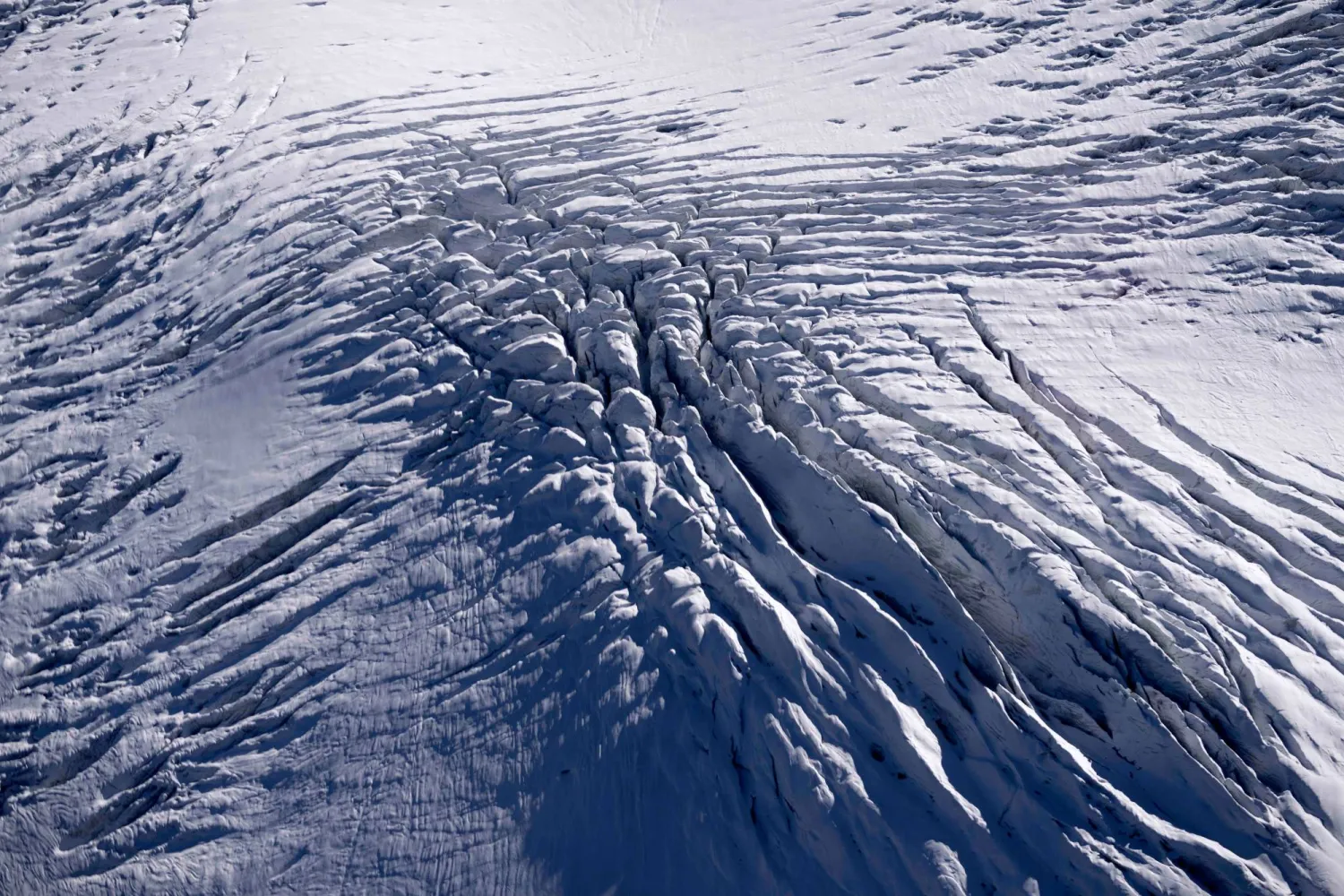
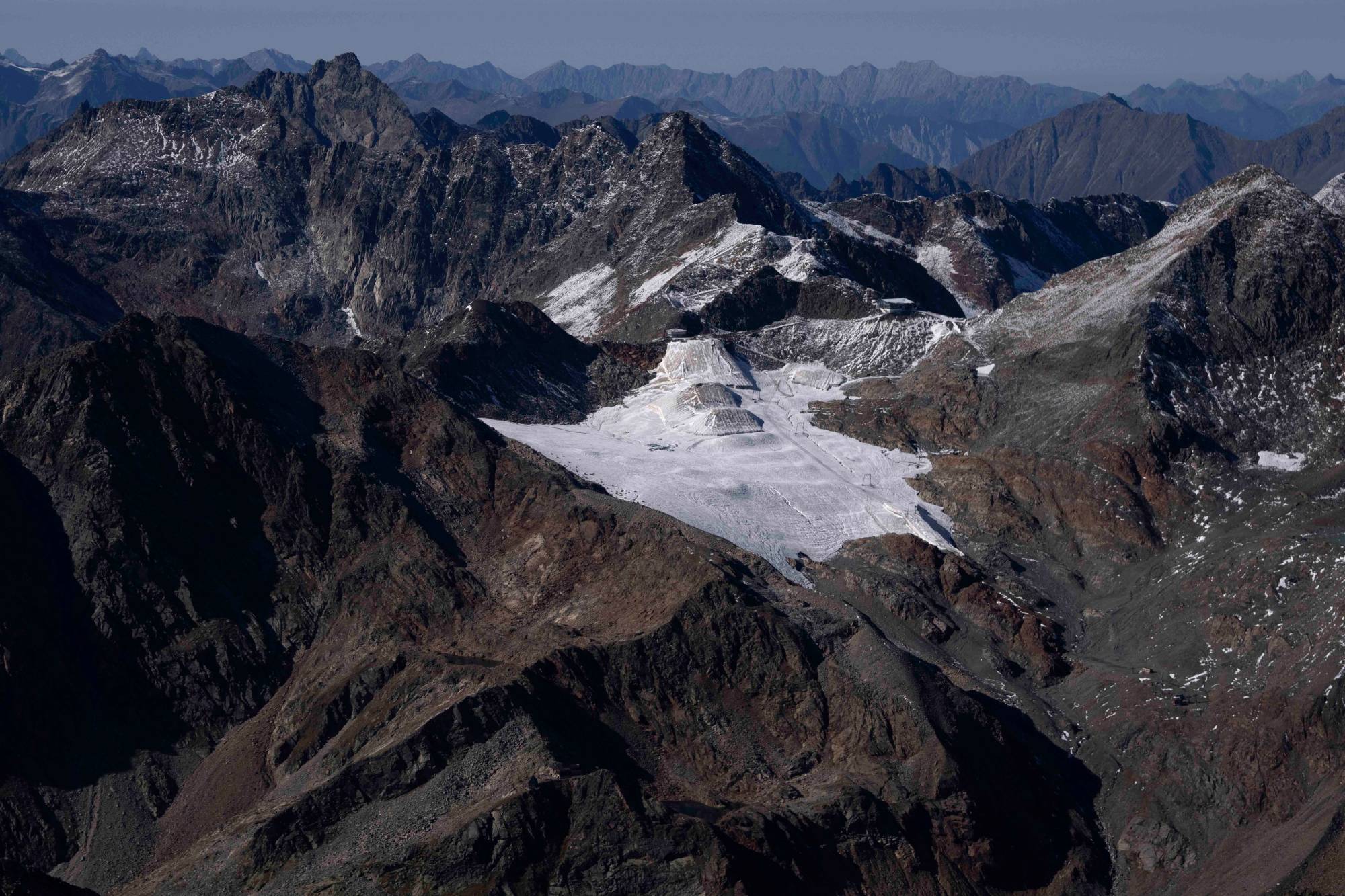
All but two of Austria’s 96 glaciers have retreated over the last two years, monitors in the Alpine country reported Friday, saying the “dramatic development” highlights the impact of climate change.

The latest report from the Austrian Alpine Club shows the Alpeiner Ferner in the western Tyrol region and Stubacher Sonnblickkees in Salzburg to the east are facing the greatest loss, each with a retreat of more than 100 meters (about 330 feet). The average retreat was more than 20 meters (65 feet).

“The disintegration of the glacier tongue is also progressing at the Pasterze, Austria’s largest glacier, making the consequences of climate change visible,” the club said in the report covering 2024 and 2025.

The report, it added, “confirms once again the long-term trend: Glaciers in Austria continue to shrink significantly in length, area, and volume.”

FILE - The Gaisskarferner Glacier is visible near Innsbruck, Austria, Monday, Sept. 25, 2023. (AP Photo/Matthias Schrader, file)

The retreat of glaciers in Europe has vast implications for drinking water, power generation, agriculture, infrastructure, recreational activities, the Alpine landscape and more.

Neighboring Switzerland, which is home to the most glaciers in Europe, has noted a similar retreat in its glaciers in recent years, a trend that has been reported around the world.

Poor weather conditions including low snowfall, warm temperatures including an exceptionally hot June last year — nearly 5 degrees Celsius (9 degrees Fahrenheit) above the average — have contributed to the retreat, The Associated Press quoted the club as saying.

“The glaciers are melting — and with every new report, the urgency grows,” club vice president Nicole Slupetzky said. “It’s no longer a question of whether we can still save the glaciers in their old form; it’s about mitigating the consequences for ourselves.”

Such changes in the Alps should serve as a “wake-up call” for policymakers and the public in its behavior, the club said.

It said the current figure was lower than during the previous two years, but still ranks as the eight-largest retreat in the 135 years of measurements.
